
Carl wanted to play Scrabble.
Most of the patients Selena visited through her hospice volunteer work asked for practical things — a warm meal, someone to sit with them while the afternoon stretched out. Carl, 40 years old and living alone in a house crowded floor to ceiling with books, pointed at the game board before she had even taken off her coat.
“Do you cheat?” he asked.
“Only when necessary,” she said.
He studied her. “We may get along.”
They did — for four months of weekly visits that became twice weekly, then three times. Selena brought soup and washed dishes. Carl remembered, without being asked, how she took her tea. He had stage four cancer and no illusions about the trajectory. He simply refused to let illness become the largest thing in the room. When pain interrupted a conversation mid-sentence, he waited for it to pass and picked up exactly where he had stopped.
Then one afternoon, Selena arrived to find him wearing a pressed blue shirt. A small velvet box sat on the table beside his tea.
“Marry me, Selena,” he said.
She nearly dropped the grocery bag.
Carl gave a tired smile. “I know how that sounds.”
“We’ve known each other four months.”
“Four very competitive months,” he said.
Selena did not laugh. Carl folded his hands, and the levity left his face.
“I filled out hospital paperwork this morning. Every line for next of kin was blank.” His fingers rested beside the velvet box. “I’m asking whether my last chapter can have someone holding my hand.”
She sat down across from him. “You deserve more than pity, Carl.”
“I agree.”
“Then why me?”
He looked toward the bookcase for a long moment. “Because you never make kindness feel like charity.”
Selena had spent years sitting with dying people. She knew the danger of confusing compassion with love. But what she felt for Carl was not obligation. She said yes.
A priest married them in Carl’s living room the next afternoon. When Carl’s hand shook too badly to place the ring on her finger, Selena guided it with hers. He exhaled as though he had finally reached shore.
For 10 days she was his wife. She cooked while he directed her from a chair. They watched old movies. She read aloud when his eyes grew tired. On the eighth night she found him holding a worn novel against his chest, the cover faded beyond recognition.
“What book is that?”
“My favorite.”
“May I see it?”
He pressed it against his chest like a shield. “Not yet.”
She teased him about being secretive. He smiled, and did not hand it over.
Carl died two mornings later with her hand beneath his. His final breath came so gently that Selena did not recognize it as an ending until the room stayed still.
Fewer than 20 people came to the funeral. Most were former students. One left a paper lunch bag beside the coffin. Another left a blue birdhouse, handmade. Selena stood at the graveside believing she had given a lonely man 10 days of company.
That evening, someone knocked on her door.
The man on the porch wore a charcoal coat and carried a leather case. He introduced himself as Mr. Baron, Carl’s attorney. He had an envelope in his hand and a careful expression on his face.
“When I last spoke with Carl,” he said, “he made me promise not to come until after the funeral. He said you needed to grieve the man you knew before learning who he had been.”
The letter inside was written in Carl’s careful handwriting.
Selena — Our meeting was not an accident. Before I became your husband, I was the awkward boy who lived two houses down from you on Silver Oak Street and spent every autumn hoping you’d stop by Arthur’s workshop.
Selena’s knees struck the floor.
Mr. Baron caught her elbow, but the letter fell.
Silver Oak Street. Arthur’s workshop. Sawdust and bicycle grease. She had lived there until she was 14, when her parents died in a car accident and she was placed in foster care. Strangers packed up the house while she sat in a county office holding a trash bag of clothes. She never went back.
“I knew a boy,” she said slowly. “Quiet. Dark hair.”
“Carl,” Mr. Baron said.
The denial came before she could stop it.
The Carl she had known as a girl was shy, almost wordless — a teenager who lived with his grandfather and repaired bicycles behind the old workshop. The man she had married laughed easily and fought over book titles. Mr. Baron told her Carl had lost both parents at age seven. Arthur, the grandfather, raised him.
Then the smaller memories began surfacing.
Arthur’s cracked hands. His handmade birdhouses. Selena’s mother sending her over with soup when Arthur caught the flu, because nobody should eat alone while sick. Carl standing half-hidden behind the workshop door, watching.
One Saturday afternoon, an impatient customer confronted Carl about a bicycle repair. When Carl opened his mouth to explain, his stutter took over. The customer grabbed the bicycle and left. Carl disappeared behind the workshop before anyone could speak.
Selena had found him sitting on the curb. She did not tell him it wasn’t his fault. She sat down next to him and started talking about a stray kitten she’d found under her family’s porch — how it hated milk, loved shoelaces, had bitten her father. By the time they walked back to the workshop, Carl was smiling.
She had completely forgotten that afternoon.
Carl had not.
Mr. Baron placed the letter back in her hands. She read on.
You spoke to me as though nothing had happened. I was certain one bad moment had changed how everyone would see me. Then you asked whether I thought the kitten needed a name. You gave me something to stand on when pity would have made it worse.
Mr. Baron set a worn leather journal on the table. Inside the cover, Carl had written her name. The first dated entry was from the year after she left Silver Oak Street.
Selena, Age 15. I hope high school is kinder than last year.
The entries continued, one for every birthday.
Age 18. I hope she finds a place where nobody packs her life into bags.
Age 20. I hope someone laughs when she laughs.
Mr. Baron told her Carl became a history teacher. He kept extra lunches in his desk for students who came to school hungry. He stayed late for kids who dreaded going home.
“He didn’t center his life around finding you,” Mr. Baron said. “He centered it around becoming the person your kindness taught him to be.”
Selena asked why Carl had never tried to contact her.
“He did, once.” Mr. Baron produced a yellowed envelope, addressed to a foster home, returned unopened. After that, Arthur had told Carl to let her build a life without an old neighborhood reaching into it.
When Carl’s diagnosis came, he saw Selena’s name on the hospice volunteer list. He made one request: her, if she was willing. Not to reveal who he was. Just to meet the woman she had become.
His letter explained the rest.
You walked in with vegetable soup, moved my laundry without making me feel weak, and argued that “qi” was an acceptable Scrabble word. I knew — not because you looked the same, but because you made the room easier to stand inside.
He had not told her who he was, the letter explained, because he knew she would have said yes from guilt. He wanted her answer to remain free.
Mr. Baron then placed the faded novel on the table and opened it.
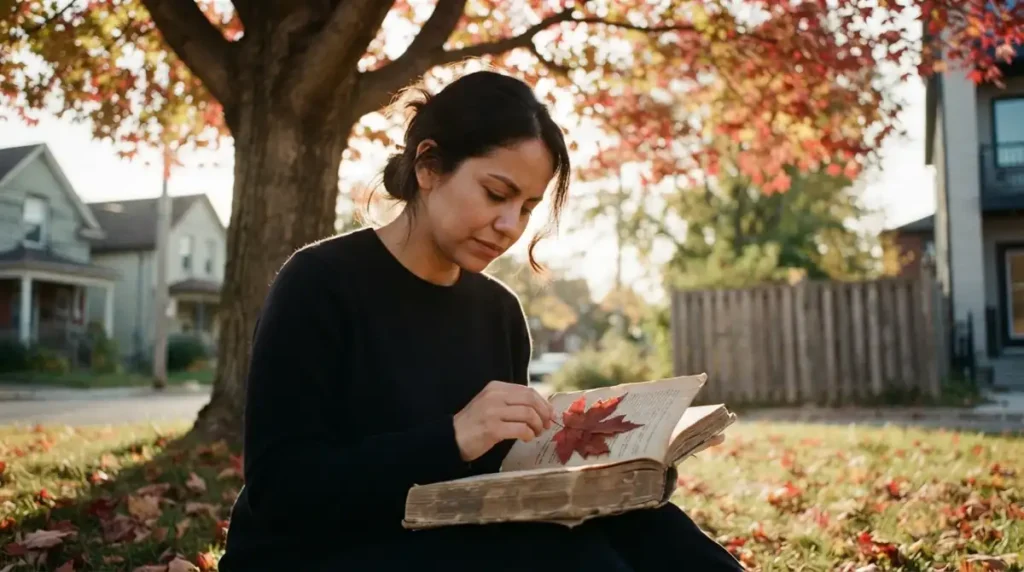
Between two pages rested a pressed red maple leaf, brittle with age.
Memory moved faster than thought. One autumn on Silver Oak Street, Selena had borrowed Carl’s favorite book. When she returned it, she had slipped a bright red leaf between the pages. “Now you’ll never lose your place,” she had joked.
Carl had carried it for more than 20 years.
The last journal entry was dated three days after their wedding.
Age 35. She did.
Below it, one more line: And so did I.
Six weeks later, Selena drove back to Silver Oak Street.
Arthur’s house was gone. The workshop had been replaced by a narrow apartment building. The bicycle rack had vanished. Only the maple tree remained. She sat beneath it with Carl’s novel in her lap, and when she opened the book, the pressed leaf drifted loose and settled on her knees.
Carl had opened those pages for decades — whenever life made him doubt whether a single ordinary afternoon had mattered. He saw a girl on a curb, talking about a kitten. A red leaf tucked inside a borrowed book. Nothing heroic. Nothing Selena had thought twice about.
She placed her palm over the leaf for a moment, then let it fall beside the roots.
Not discarded. Returned.
She closed the novel and carried it home.

All comments are subject to our Community Guidelines. Opinions belong to readers.