

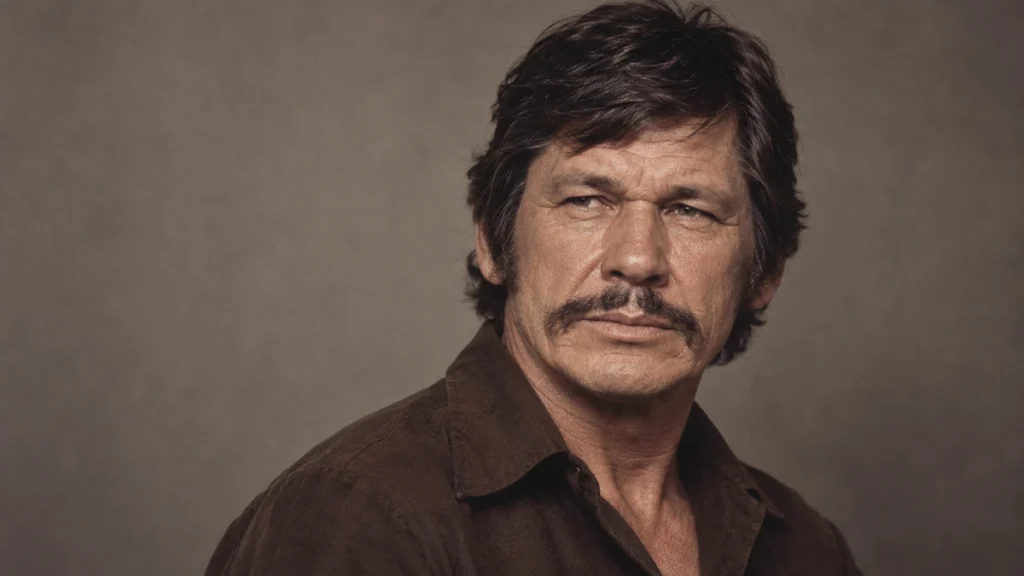
He spent years in supporting roles before becoming an international star. Away from the cameras, his life included a large family, three marriages, and a love of painting.
You knew the face before you knew the name. The deep lines, the narrowed eyes, the look that made a threat unnecessary. Charles Bronson played men who had worked hard, taken a few hits, and learned to keep quiet.
Getting to leading-man status took him a long time.
Growing up in coal country
He was born Charles Dennis Buchinsky on November 3, 1921, in Ehrenfeld, Pennsylvania – the 11th of 15 children. His father was a Lithuanian immigrant, his mother was Lithuanian-American, and the family lived in hard, grinding poverty.
By his teens he was down in the coal mines himself. In 1943 he enlisted and ended up as a B-29 aerial gunner in the Pacific during World War II.
When he was discharged in 1946, he bounced between odd jobs – cooking, laying bricks. It was a Philadelphia theater troupe that first pulled him toward acting. He stuck with it, moved to California, studied, and started picking up small TV and film roles.
Becoming Charles Bronson
His earliest credits still say Buchinsky. He changed it in 1954, right in the middle of Hollywood’s Red Scare. A Russian-sounding name was a liability, so he picked Bronson.
The new name didn’t mean instant fame. He ground it out through the 1950s, guest spots and B-movies, until he finally got a title role in Machine-Gun Kelly in 1958.
Then came the ensemble classics that put him in front of everyone: The Magnificent Seven (1960), The Great Escape (1963), The Dirty Dozen (1967). It was Europe that actually made him a leading man – Adieu l’ami and Sergio Leone’s Once Upon a Time in the West, both in 1968.
By that point he was already in his forties. Audiences had been seeing him for more than a decade without quite knowing what to do with him.
The films that made him a star
Most of what people remember is Westerns, war movies and crime thrillers. The Mechanic (1972) gave him that cold, methodical hitman persona. Death Wish (1974) cemented it.
As Paul Kersey, an architect who becomes a vigilante after his family is attacked, Bronson became both a box office draw and a lightning rod. The film’s take on revenge divided critics and audiences, and it spawned four sequels.
It overshadows some of his best work. In Hard Times (1975), he plays a Depression-era bare-knuckle fighter opposite James Coburn. Roger Ebert called it “a definitive Charles Bronson performance.” It’s quiet, physical, and it shows what he could do when he didn’t have to say much at all.
That was the trick with Bronson. He never looked like he was trying to impress anyone in the scene. A measured line, a sideways glance, and he had you.
His marriage to Jill Ireland
Bronson was married three times. His first marriage to Harriet Tendler produced two children.
In 1968 he married British actress Jill Ireland. They had met on the set of The Great Escape – at the time, she was married to his co-star David McCallum. After Ireland and McCallum divorced, she and Bronson married.
She became his most frequent co-star and his partner off-screen. They had a daughter, Zuleika, and adopted a daughter, Katrina. They were together until Ireland’s death in 1990.
He married Kim Weeks in 1998, and they remained together until his death.
Away from the cameras
Bronson died on August 30, 2003, at 81.
We remember the gunfighters and the tough guys, but those who knew him away from set describe a very different private life. He painted, often and seriously, and spent most of his time out of the spotlight with his family. Brush and canvas instead of a sidearm.

All comments are subject to our Community Guidelines. Opinions belong to readers.