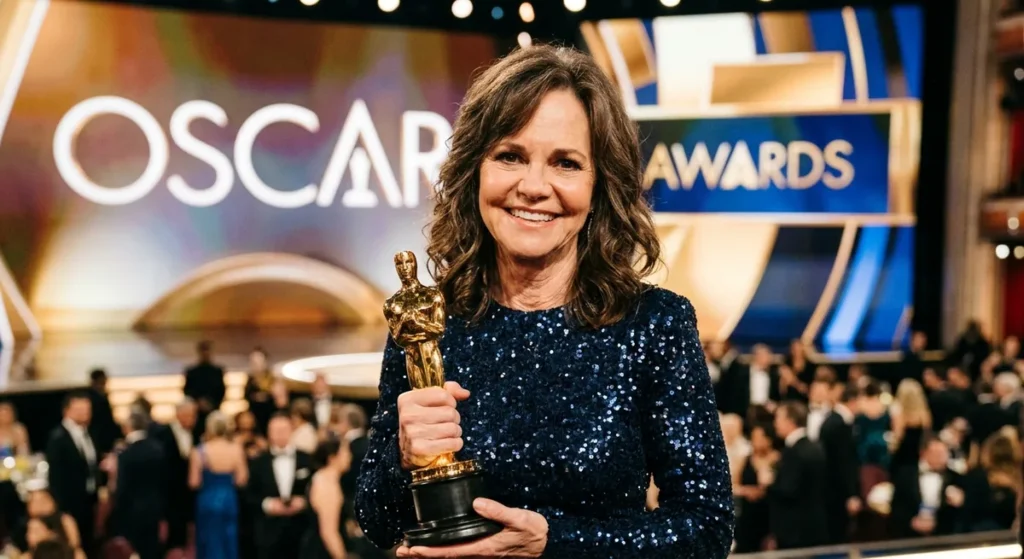
When Sally Field’s name was read out at the Emmys on September 14, 2026, she looked honestly caught off guard. “This wasn’t supposed to happen!” she told the room as she accepted the award for lead actress in a TV movie for Netflix’s Remarkably Bright Creatures. At 79, she became the oldest woman ever to win the category. It was her fourth Emmy, and it arrived more than six decades after she first stood in front of a camera.
That first job came with a surfboard and a permanent smile. The road from there was longer, and far more private, than her sunny early roles ever let on.
The Girl on the Surfboard
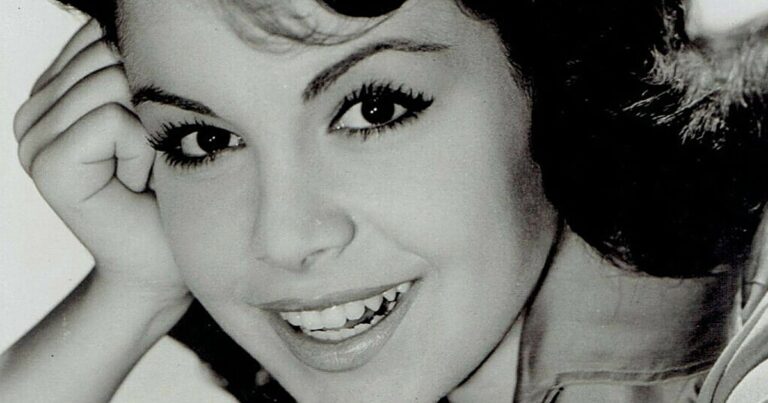
Sally Margaret Field was born on November 6, 1946, in Pasadena, California. In the fall of 1964, at 17 and just out of high school, she said her first lines as a professional actor on a freezing beach in Malibu. “A few months later, this show was picked up and all of a sudden I was the star of a television series,” she recalled when she accepted the SAG Life Achievement Award in 2023.
The show was Gidget, which premiered on ABC in September 1965. It was the era of wholesome teen favorites like Annette Funicello, and Field’s bubbly Frances “Gidget” Lawrence fit right in. ABC canceled the series after one season, only to watch its summer reruns find a bigger audience than the original run ever had. The show was gone, but its star was now a familiar face.
ABC soon had her in a habit for The Flying Nun, which ran from 1967 to 1970. Field wanted no part of it at first. She did not want to play what she called “a cutesy version of a Catholic nun,” and she said no. According to her memoir, it was her stepfather who changed her mind, showing up at her apartment to warn her, “If you don’t do this show, Sally, you may never work again.” As People reported from the book, she took the part, and “for three years I was the Flying Nun.”
What She Carried at Home
Her mother, the actress Margaret Field, had divorced Sally’s father and in 1952 married Jock Mahoney, a stuntman and actor the family called Jocko. In her 2018 memoir In Pieces, Field writes that he sexually abused her, beginning when she was a young girl and continuing until she was 14.
She does not reduce him to a simple villain. “It would have been so much easier if I’d only felt one thing, if Jocko had been nothing but cruel and frightening,” she writes. “But he wasn’t. He could be magical, the Pied Piper with our family as his entranced followers.”
“To be seen, to be loved, I also had to be terrified and I couldn’t ever say what I was really feeling. So I had to be invisible,” she told NPR. The book’s title came from the same place. “I am in pieces and sort of always have been since childhood,” she said.
The Years Nobody Would Let Her In
When The Flying Nun ended, the work dried up. She has recalled signing autographs while waiting in line for unemployment. Casting offices had already decided what she was. “I couldn’t get on the list. They thought they already knew what I was,” she told People in May 2026.
Her answer was to get better. She began studying at the Actors Studio with Lee Strasberg. Among the “really working actors” in those packed sessions was Jack Nicholson. He saw her work and recommended her as “an undiscovered talent” to casting director Dianne Crittenden and director Bob Rafelson. That led to her first real audition since Gidget, for Rafelson’s Stay Hungry (1976), opposite Jeff Bridges and a young Arnold Schwarzenegger. “I worked at the Actors Studio for so long, and it was so hard, that Jack had seen it and the word spread,” she said.
Sybil, Norma Rae, and Two Oscars
The same year brought the role that changed how the industry saw her. In NBC’s Sybil, which aired in November 1976, she played a young woman with multiple personalities, opposite Joanne Woodward as her psychiatrist. It won Field her first Emmy in 1977.
Parts like that gave her something she had not had growing up. “I was able to feel something I didn’t feel before. I heard my voice,” she told The New York Times in 2018.
After Smokey and the Bandit made her a box-office name in 1977, she found that voice on the big screen in Norma Rae (1979), Martin Ritt’s drama about a Southern textile worker who helps unionize her mill. The role won her Best Actress at Cannes and then at the Academy Awards. Five years later she won a second Best Actress Oscar for Places in the Heart (1984), as a Depression-era widow fighting to keep her Texas farm. Her speech is still quoted, usually only in part. “I haven’t had an orthodox career and I’ve wanted more than anything to have your respect,” she told the Academy. “The first time I didn’t feel it, but this time I feel it. And I can’t deny the fact that you like me. Right now, you like me!”
Telling Her Mother
For most of her life, Field never told her mother the full story. Margaret had known about a single incident, which Mahoney confessed and which contributed to the couple’s 1968 divorce, Field told The Irish News. She did not know it had gone on for years.
The conversation finally happened when Margaret was dying of cancer, with the help of a therapist Field had found, and soon after Field learned she had won the role of Mary Todd Lincoln in Steven Spielberg’s Lincoln. She made her mother dinner and told her. It was hard for Margaret to hear. But the next morning, frail as she was, she assured her daughter that she would not be alone in that pain any longer. Margaret Field died at her Malibu home on November 6, 2011, Sally’s 65th birthday. The role her daughter had fought for brought a Best Supporting Actress Oscar nomination.
Still Working, Still Surprised
Field spent about six years writing In Pieces, which Grand Central Publishing released on September 18, 2018. Days before its release, she was still asking herself, “Can I just pull this back?” Then she added, “But I didn’t.”
By then she had added Steel Magnolias, Mrs. Doubtfire and Forrest Gump to her films, Emmys for ER (2001) and Brothers & Sisters (2007), and Aunt May in The Amazing Spider-Man. When her Spider-Man co-star Andrew Garfield handed her the SAG Life Achievement Award in February 2023, she looked back without pretending any of it came easily. “Easy is overrated,” she said. “There is not a day that I don’t feel quietly thrilled to call myself an actor.”
Three years later, on that Emmy stage, the woman who once believed she had to be invisible used her moment to speak up for everyone in the room. “We’re the arts. We matter,” she said. “Our voices matter.”